July 2026 | Health Systems & Financing
Bangladesh has committed to achieving Universal Health Coverage by 2030. Yet out-of-pocket health expenditure stands at 68.5%, public health investment remains at just 0.67% of GDP, and external support is declining. The problem, a new study finds, is not only how much the country spends on health — it is how, and whether, allocated money actually gets spent.
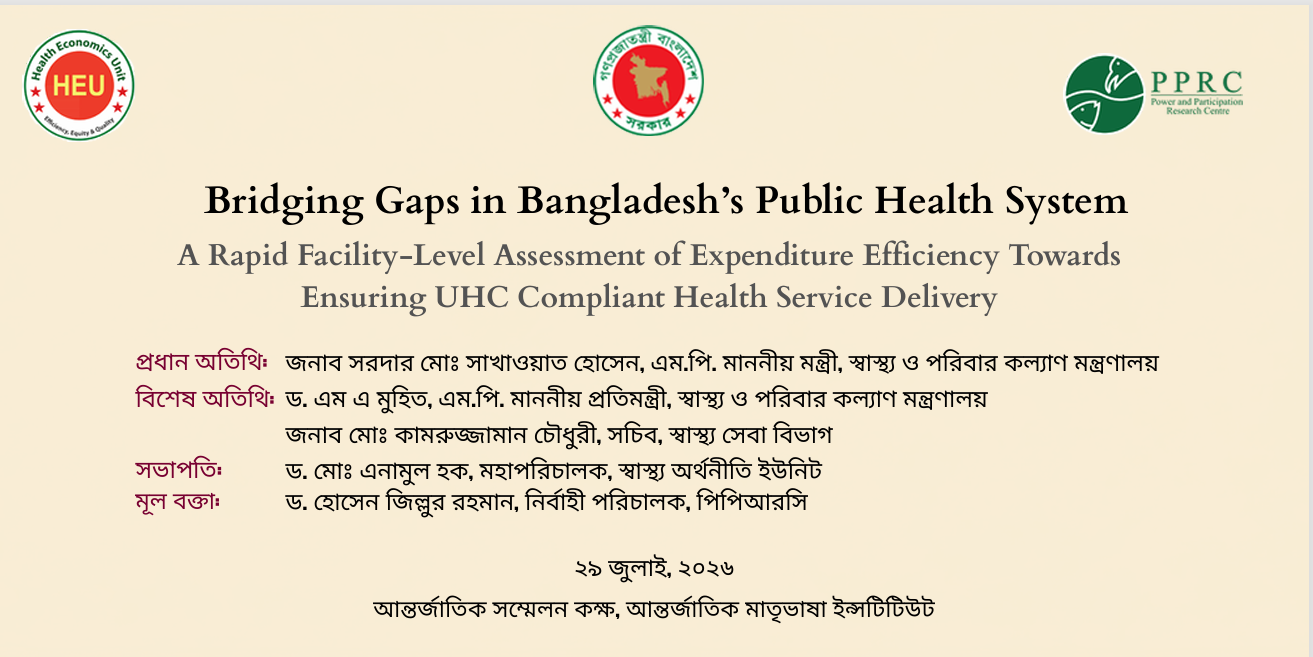
The Power and Participation Research Centre (PPRC), commissioned by the Health Economics Unit (HEU) of the Ministry of Health and Family Welfare, has completed a rapid facility-level assessment of expenditure efficiency in Bangladesh’s public health system. The study, Bridging Gaps in Bangladesh’s Public Health System, diagnoses why health facilities across the country struggle to convert budget allocations into functioning services — and what can be done about it.
The Policy Brief is available below.
About the Study
PPRC conducted a mixed-method, cross-sectional study covering 22 public health facilities across all eight administrative divisions — spanning tertiary hospitals, district-level secondary facilities, Upazila Health Complexes, and Union Health Sub-Centres. The research combined a retrospective budget analysis, facility functionality surveys, a knowledge-attitudes-practices (KAP) survey of facility staff, and 32 qualitative interviews with facility managers, contractors, policymakers, and patients.
The analysis was guided by an integrated framework linking Public Financial Management (PFM) with the WHO Health System Building Blocks, connecting upstream governance and financing constraints to downstream facility performance and patient experience.
What the Study Found
Money is allocated but not spent. Average budget utilization in FY2024–25 stood at 85%, but 94% of facilities reported unspent budget at year’s end. Critically, only 11% of respondents perceived financial mismanagement — under-spending is driven not by corruption but by structural and procedural barriers: rigid line-item budgets, delayed fund releases, lengthy multi-layered approvals, and centralized control over even routine reallocations.
Equipment exists; people to run it do not. Nearly 40% of sanctioned medical technologist posts nationally remain vacant. Diagnostic equipment sits idle: while imaging services are nominally available at up to 85% of secondary facilities, sustained availability is as low as 17–33%, driven mainly by non-functional equipment and staffing shortages.
Essential medicines are critically scarce. Current essential medicine availability is just 22.7% at primary level, 23.9% at secondary, and 11.5% at tertiary facilities — constrained by EDCL production limits and procurement rules that restrict facilities from sourcing alternatives when supplies fall short.
Budget rules don’t match real needs. Fixed percentage allocations for medical and surgical requisites — unrevised in over a decade — leave facilities chronically underfunded in items like reagents while over-allocating others. Redistribution requests take months, often outlasting the fiscal year.
Fear drives under-spending. Facility managers described a pervasive fear of audit objections, where even minor remarks carry perceived consequences for pensions and careers. Combined with limited training in financial management — many managers are clinicians promoted into administrative roles — this produces risk-averse behavior and systematic under-utilization.
Data is collected but not used. While 58% of facilities report using data for decision-making, systems remain fragmented and partially paper-based. IBAS++ is not fully operational at the upazila level, and budget decisions rely on historical allocations rather than performance analysis.
What the Study Recommends
The study proposes a phased reform agenda:
Short term: Recruit and deploy trained medical technologists to activate idle equipment; mandate disaggregated budget performance analysis by economic code and by operating versus development budgets; strengthen integrated data systems and real-time dashboards; and simplify procurement procedures with emergency flexibility provisions.
Medium term: Establish a dedicated health management cadre to professionalize facility administration, and decentralize financial authority with greater flexibility in MSR coding so facilities can match spending to local needs.
Long term: Modernize EDCL production capacity and improve CMSD efficiency to secure the medicine supply chain.
Why It Matters
The study’s central message is that Bangladesh’s path to UHC runs through governance, not just financing. Without addressing the systemic constraints that keep allocated funds unspent — fragmented authority, outdated expenditure rules, managerial insecurity, and weak information systems — even increased health budgets will fail to translate into better services for patients.
Dissemination
The findings were unveiled on 29 July 2026 at the International Conference Room of the International Mother Language Institute, Dhaka. Sardar Md. Sakhawat Hossain, MP, Hon’ble Minister for Health and Family Welfare, graced the event as Chief Guest, with Dr. M A Muhit, MP, Hon’ble State Minister for Health and Family Welfare, and Md. Kamruzzaman Chowdhury, Secretary, Health Services Division, as Special Guests. The session was chaired by Dr. Md. Enamul Haque, Director General of the Health Economics Unit, and the keynote presentation was delivered by Dr. Hossain Zillur Rahman, Executive Chairman, PPRC.