
Overview
Understanding the economy through the household
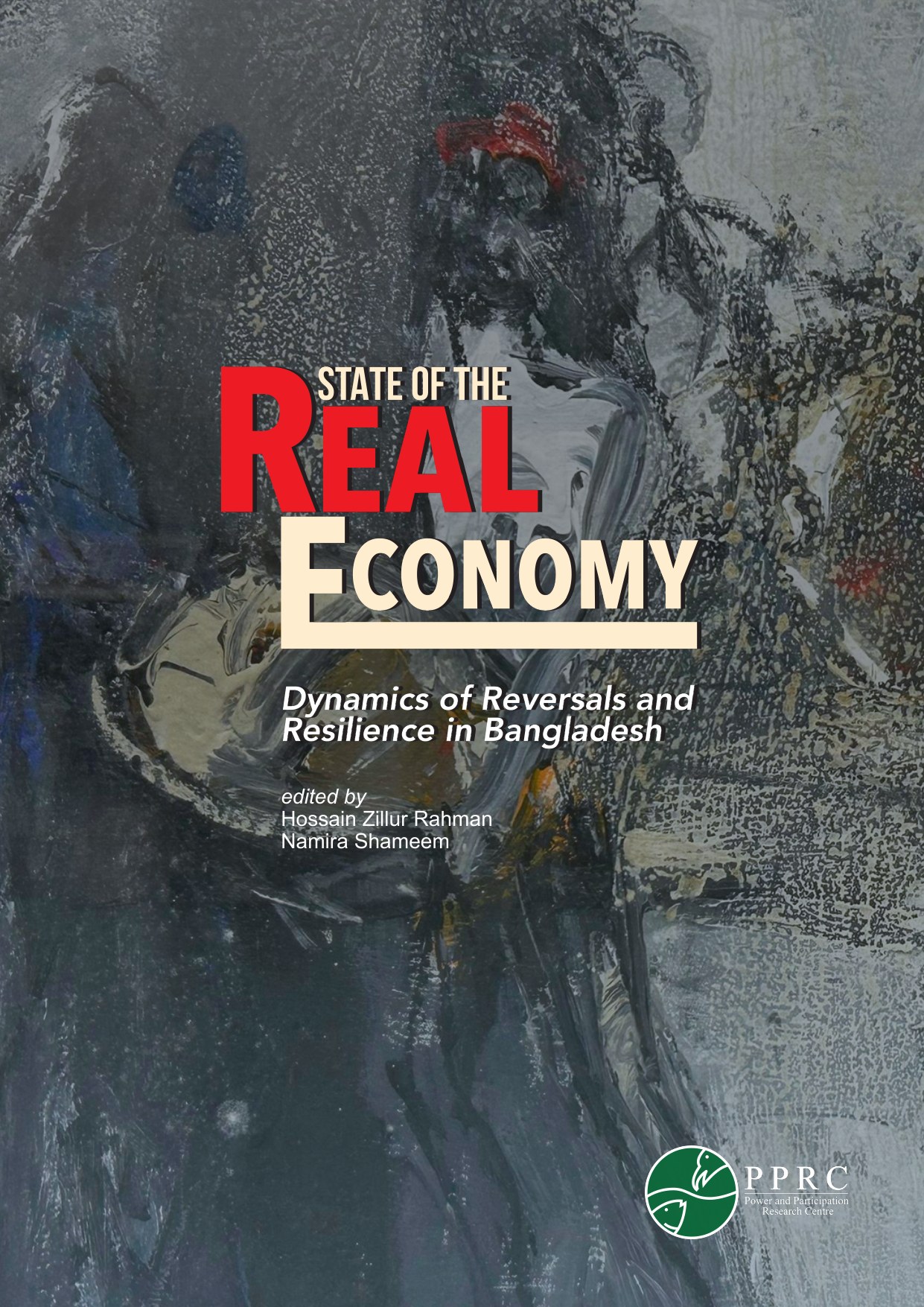
State of the Real Economy: Dynamics of Reversals and Resilience examines how successive economic, social and political shocks have reshaped household wellbeing in Bangladesh. Drawing on a nationally representative survey of 8,067 households conducted in 2025, it analyses employment, income and expenditure, debt, food insecurity, chronic illness, social protection, institutional harassment, poverty, inequality, digital participation and household expectations. PPRC highlights the coexistence of persistent resilience with growing economic fragility and proposes a transition compact for more inclusive and secure development.
Abstract
This publication presents a multidimensional assessment of Bangladesh's real economy from the perspective of households. Based on a nationally representative survey of 8,067 households conducted in 2025, it examines changing household structures, employment and income, expenditure pressures, savings and debt, food insecurity, chronic illness, exposure to shocks, access to social protection, institutional harassment, digital participation, poverty, inequality and public expectations.
The findings point to significant reversals in poverty reduction and a growing population of vulnerable non-poor households living with limited financial margins. Economic insecurity is reinforced by informal and under-employed work, survival-oriented borrowing, health-related expenditure, uneven safety-net coverage and persistent governance frictions. At the same time, households continue to demonstrate resilience through work, migration, social networks, asset use and adaptation.
The publication argues that resilience should not substitute for effective institutions and identifies the need for a transition compact linking productive employment, social protection, health financing, human-capital investment, digital capability and accountable economic governance.
What the study finds
From household survival to economic security
Household budgets have almost no room to move
For many households, income is absorbed by essentials, leaving little room to save or withstand illness, price shocks or income loss.
Poverty is only part of the story
Poverty has risen while a large vulnerable non-poor population — the fragile middle — remains close to the poverty line and exposed to downward mobility.
Pressures rarely come one at a time
Informal work, debt, food insecurity, chronic illness, limited savings, inadequate protection and governance frictions reinforce one another — it is the accumulation of these risks that makes recovery difficult.
People are coping, but coping has limits
Households continue to adapt through work, migration, networks and asset use, but these coping mechanisms cannot replace reliable institutions.
Towards a "transition compact"
The publication calls for economic democracy, new growth drivers, quality education, productive transformation and governance for speed.
Keywords
Recommended citation
Rahman, H. Z., & Shameem, N. (Eds.). (2026). State of the real economy: Dynamics of reversals and resilience in Bangladesh. Power and Participation Research Centre. https://doi.org/10.5281/zenodo.22775422
Permanent identifier: DOI 10.5281/zenodo.22775422 · ISBN 978-984-37-0584-6.