
15 September 2026 | Bishwo Shahitto Kendro, Dhaka
The Power and Participation Research Centre (PPRC), in partnership with UNICEF Bangladesh and the Directorate of Primary Education (DPE), convened a national dissemination event on the School Level Improvement Plan (SLIP) Effectiveness Study on 15 September 2026 at Bishwo Shahitto Kendro in Dhaka.
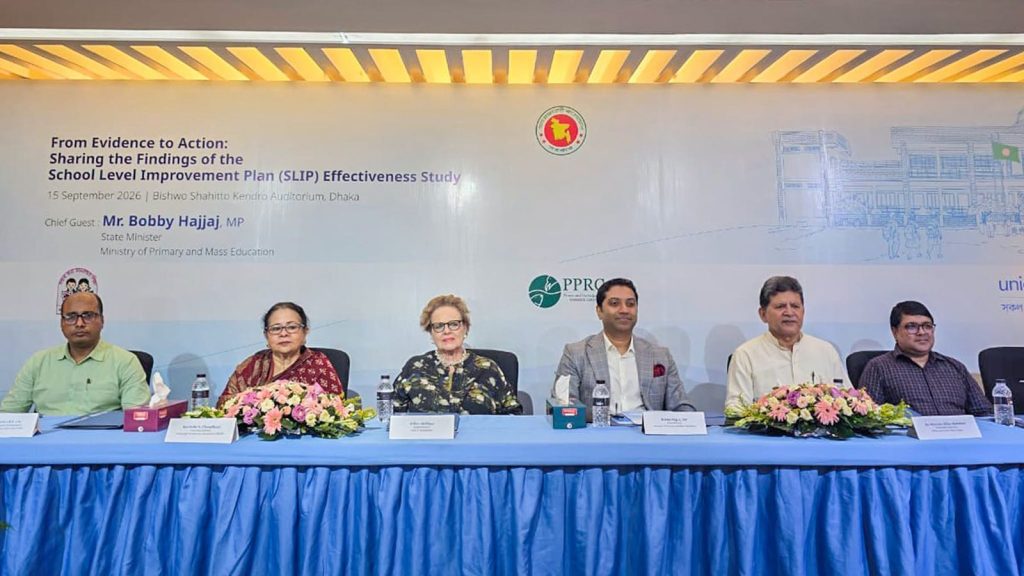
The head table at the national dissemination of the SLIP Effectiveness Study, with State Minister for Primary and Mass Education Bobby Hajjaj, MP, attending as Chief Guest.
Titled “From Evidence to Action: Sharing the Findings of the School Level Improvement Plan (SLIP) Effectiveness Study,” the event brought together policymakers, government officials, education specialists, development partners, researchers and civil society representatives to examine how school-level planning and financing can be made more responsive to the diverse realities of primary schools across Bangladesh.
Unlocking the potential of SLIP
Presenting the study findings, Dr Hossain Zillur Rahman, Executive Chairman of PPRC, highlighted the important role SLIP can play as an instrument of decentralised school management while drawing attention to gaps that continue to limit its full potential.
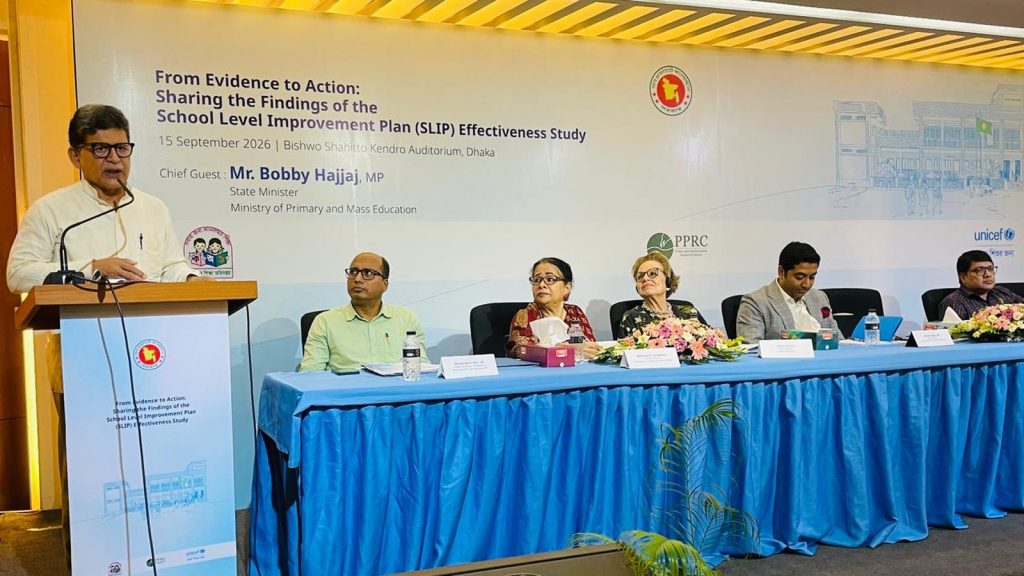
Dr Hossain Zillur Rahman, Executive Chairman of PPRC and Study Team Leader, presents the key findings and policy recommendations of the SLIP Effectiveness Study.
The study found that, despite more than a decade of implementation, meaningful decentralisation at the school level remains incomplete. Delays in fund release, reimbursement-based financing, rigid expenditure rules, limited local capacity, gaps in community participation and weaknesses in monitoring all constrain schools’ ability to use SLIP resources effectively.
The findings point towards a shift from a largely uniform grant mechanism to a more needs-responsive and learning-oriented approach. Key areas highlighted for reform included:
- moving towards advance and predictable financing, supported by appropriate verification, audit and digital tracking;
- replacing uniform allocation slabs with a differentiated formula reflecting enrolment, school-specific needs and geographical disadvantage;
- linking expenditure more closely to foundational learning and meaningful school improvement;
- strengthening the planning and management capacity of head teachers, school committees and frontline education officials; and
- giving schools greater decision-making space while integrating SLIP more effectively with the wider primary education planning system.
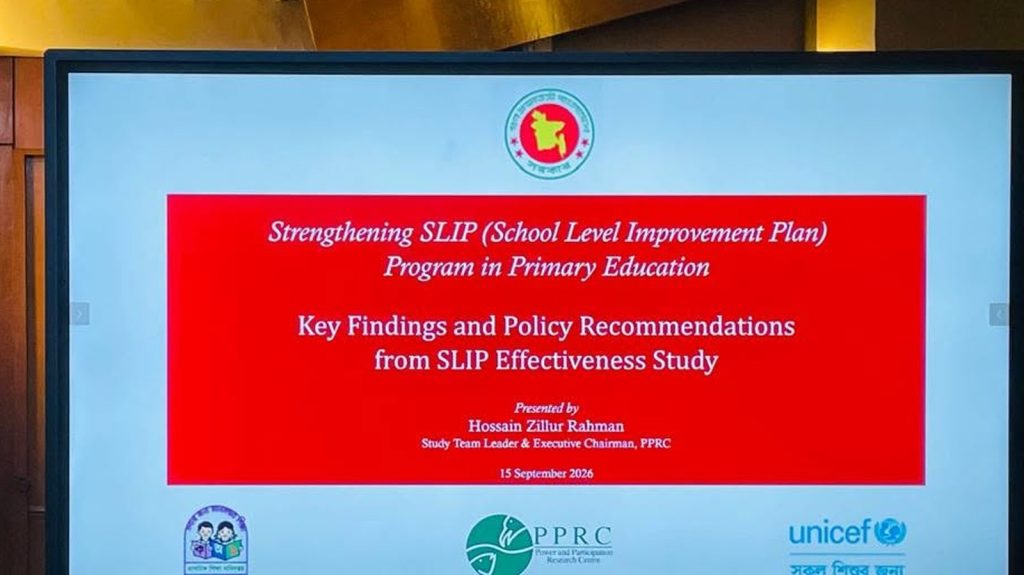
Key findings and policy recommendations from the SLIP Effectiveness Study, presented by the PPRC study team.
The study also drew attention to the very different circumstances in which schools operate. Schools serving poverty-affected, geographically remote or climate-vulnerable communities may require substantially different levels and types of support. A single allocation formula, therefore, cannot adequately respond to the diversity of needs across Bangladesh’s primary education system.
From equal allocation to equitable support
State Minister for Primary and Mass Education Bobby Hajjaj, MP, who attended the event as Chief Guest, underscored the importance of moving from equal allocation towards equity-based financing.
He argued that schools and students facing greater disadvantages should receive greater support, rather than distributing additional resources uniformly irrespective of need. Media reports from the event also noted his support for moving away from a system in which schools or teachers must first spend from their own resources and wait for reimbursement. Instead, funds could be released in advance alongside stronger monitoring and accountability.
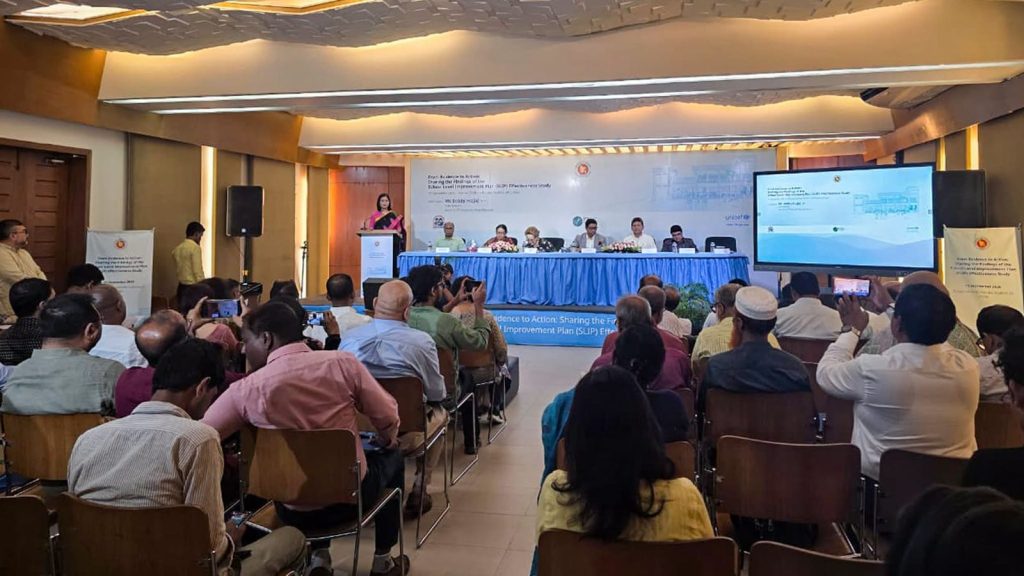
The dissemination brought together policymakers, government officials, development partners, researchers and civil society representatives.
The State Minister also emphasised clearer lines of responsibility in local school management, including stronger leadership roles for head teachers and defined responsibilities for officials at the upazila level. Discussions further considered whether routine examination expenditure should continue to draw on SLIP resources or whether those funds could be better protected for student learning and essential school improvements.
The broader discussion on equity extended beyond SLIP grants to scholarships and stipends. The State Minister stressed that financial assistance should be better targeted towards children whose education is most at risk because of poverty and vulnerability, alongside more coordinated use of stipends, educational materials and school-feeding programmes.
Putting learning, safety and student needs at the centre
The dialogue also broadened the discussion of school improvement beyond infrastructure and routine expenditure.
Rasheda K Chowdhury, Executive Director of the Campaign for Popular Education (CAMPE), called for greater attention to student voices within school planning and raised issues including school safety, drowning prevention, libraries and storybooks, WASH facilities and menstrual hygiene management.
Responding to concerns around child safety, the State Minister outlined plans for a year-round safety programme in primary schools covering issues such as road safety, fire hazards, water-related risks and natural disasters, with relevant public agencies participating in practical learning activities.
Joy Millan Maler, Education and Early Childhood Specialist at UNICEF, delivered the opening remarks, while Deepa Sankar, Chief of Education at UNICEF Bangladesh, joined the discussion. Senior representatives of the Ministry of Primary and Mass Education and the Directorate of Primary Education also participated, reflecting the importance of connecting research evidence directly with the institutions responsible for translating it into policy and implementation.
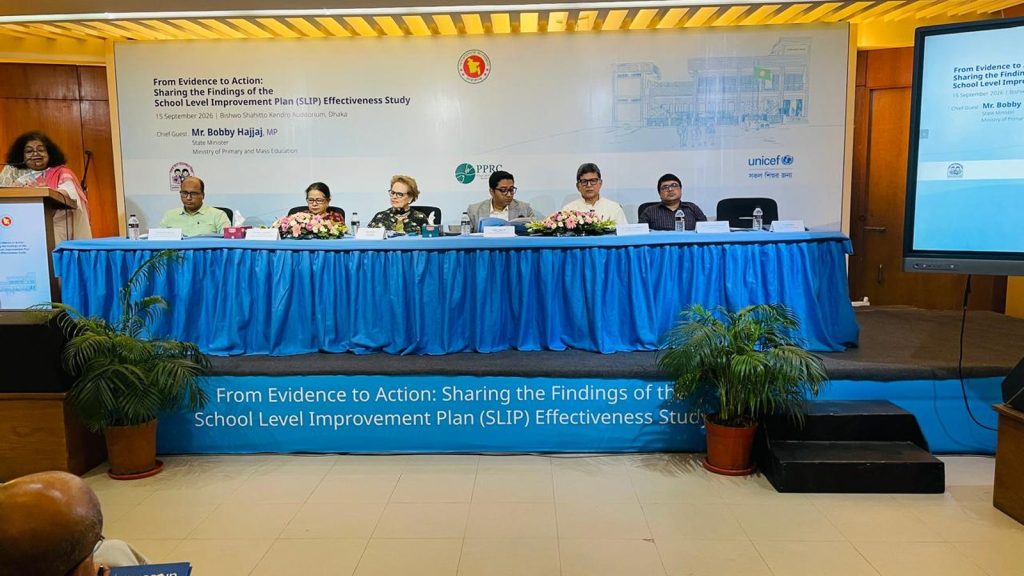
Representatives of the Ministry of Primary and Mass Education, the Directorate of Primary Education, UNICEF and PPRC took part in the discussion.
Turning evidence into implementation
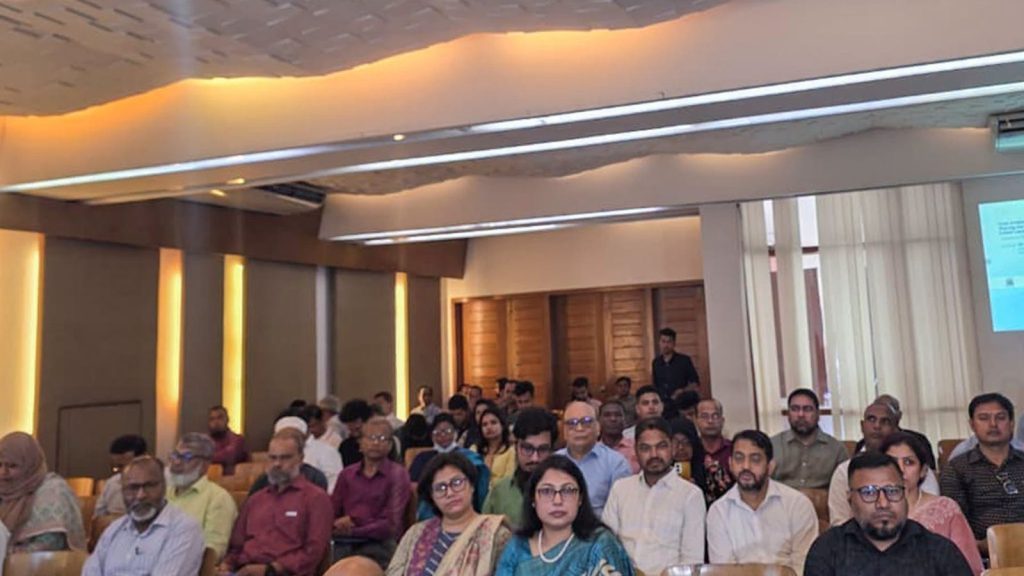
Participants at the Bishwo Shahitto Kendro auditorium during the dissemination of the study findings.
The dissemination demonstrated that the next phase of SLIP reform is not simply a question of increasing resources. It is about improving how resources are allocated, when they reach schools, who has the authority to use them, how decisions are made and how spending ultimately contributes to children’s learning and wellbeing.
In his closing reflections, Dr Hossain Zillur Rahman brought the discussion back to this central challenge: ensuring that decentralisation translates into meaningful decision-making capacity at the school level, while maintaining strong accountability and a clear focus on learning.
The study provides an evidence base for moving SLIP towards a more flexible, equitable and accountable model—one capable of responding to the very different conditions faced by schools across Bangladesh. The national dissemination marked an important step in taking that evidence beyond research findings and into the design of the country’s evolving primary education programme.
Media Coverages
- The Daily Star — Govt plans year-round safety lessons for primary students: Bobby Hajjaj — 15 September 2026.
Read coverage - The Business Standard — Equity, not equal allocation, should guide SLIP funding: Bobby Hajjaj — 15 September 2026.
Read coverage - Bangladesh Sangbad Sangstha (BSS) — Govt to prioritize equity over equality in scholarship, stipend: Bobby Hajjaj — 15 September 2026.
Read coverage - The Daily Campus — প্রাথমিক বিদ্যালয়ের স্লিপ ফান্ডের টাকা অগ্রিম দেওয়ার পরামর্শ ইউনিসেফের — 15 September 2026.
Read coverage - NTV Online — বৃত্তি-উপবৃত্তিতে ‘সমতা’ নয়, প্রয়োজনের ভিত্তিতে অগ্রাধিকার: শিক্ষা প্রতিমন্ত্রী — 15 September 2026.
Read coverage - Daily Observer — Need-based priority urged for scholarships, stipends — 15 September 2026.
Read coverage - The Energy Tribune — Govt plans equitable scholarship, stipend policies: Bobby Hajjaj — 15 September 2026.
Read coverage - The Energy Tribune Bangla — বৃত্তি-উপবৃত্তিতে প্রয়োজনভিত্তিক নীতি গ্রহণের পরিকল্পনা সরকারের — 15 September 2026.
Read coverage - The Development Times — বৃত্তি-উপবৃত্তিতে সমতা নয়, প্রয়োজনকে অগ্রাধিকার দিতে হবে: প্রতিমন্ত্রী — 15 September 2026.
Read coverage


