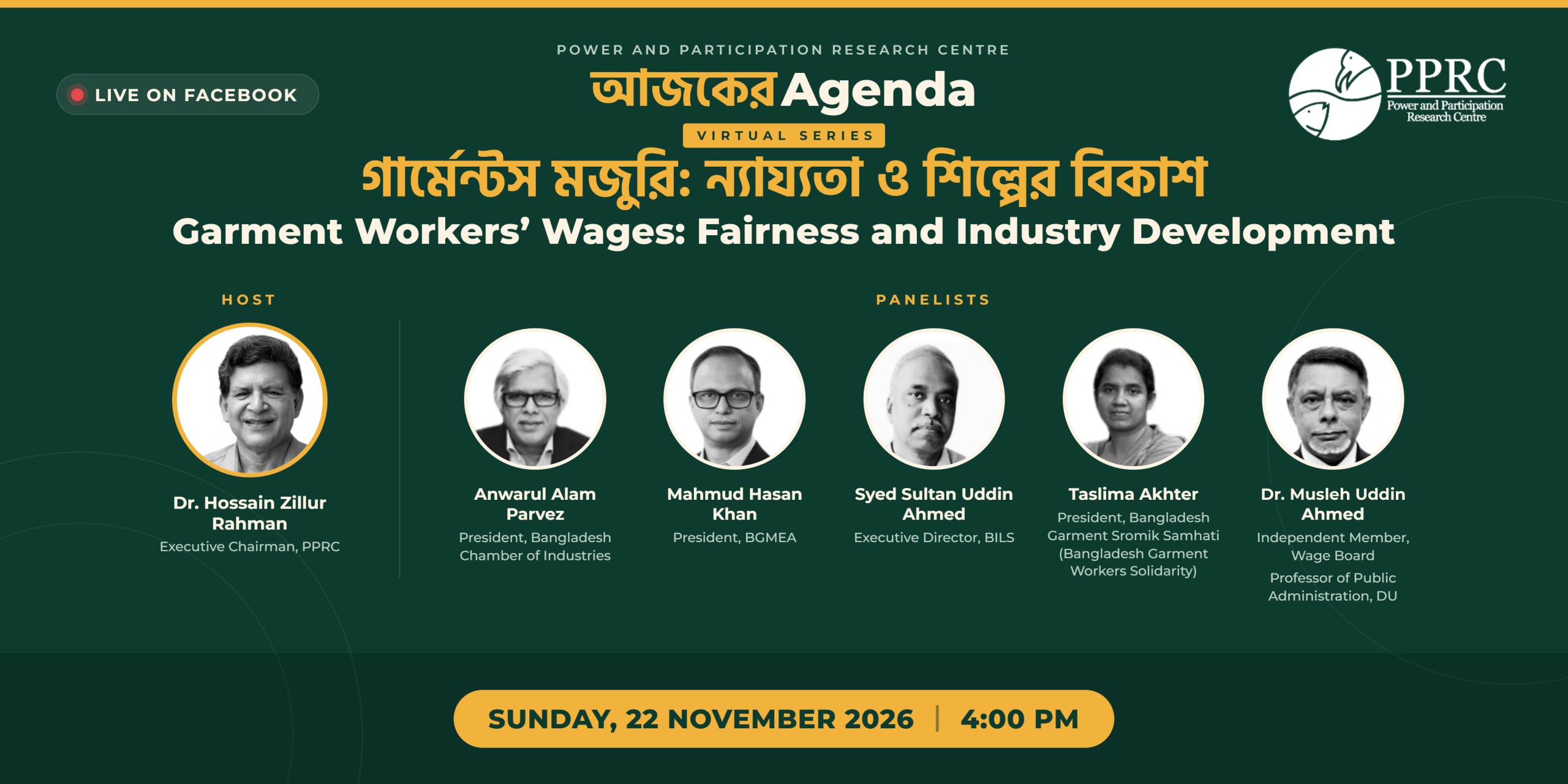
PPRC dialogue underscores the need to ensure fair wages, industrial sustainability and a dignified life for garment workers
Dhaka, 22 November 2026: Representatives of Bangladesh’s garment industry, labour organisations and the Minimum Wage Board highlighted the need for a permanent, transparent and evidence-based wage-setting framework that can reconcile workers’ demands for fair remuneration with the sustainability and competitiveness of the ready-made garment (RMG) industry. The discussion took place at a virtual dialogue titled “Garment Workers’ Wages: Fairness and Industry Development”, organised by the Power and Participation Research Centre (PPRC) under its Ajker Agenda series on Sunday.
Hosted and moderated by Dr. Hossain Zillur Rahman, Executive Chairman of PPRC, the discussion brought together Anwarul Alam Parvez, President of the Bangladesh Chamber of Industries (BCI); Mahmud Hasan Khan, President of the Bangladesh Garment Manufacturers and Exporters Association (BGMEA); Syed Sultan Uddin Ahmed, Executive Director of the Bangladesh Institute of Labour Studies (BILS); Taslima Akhter, President of Bangladesh Garment Sromik Samhati; and Dr. Musleh Uddin Ahmed, Independent Member of the Minimum Wage Board and Professor of Public Administration, University of Dhaka.
Opening the dialogue, Dr. Rahman observed that the revision of garment workers’ wages had become a pressing national concern, particularly ahead of the Minimum Wage Board’s scheduled meeting on 23 November. He identified three interconnected priorities: ensuring fairness in wages, sustaining industrial growth and establishing an orderly institutional process for wage determination. He noted that the absence of adequate advance preparation and a clearly defined framework has repeatedly allowed wage negotiations to become contentious.
A central issue was the basis on which the new wage should be determined. The entry wage of Tk 12,500 established in November 2023 has since been subject to annual increments of 5% and 9%, applied to basic pay, alongside corresponding adjustments to house rent. During the discussion, Dr. Rahman calculated that these adjustments brought the earlier wage structure to approximately Tk 15,044 in 2026. He observed that this largely represented an adjustment for inflation rather than an increase in real wages. He argued that improvements in workers’ earnings should also reflect broader economic progress.
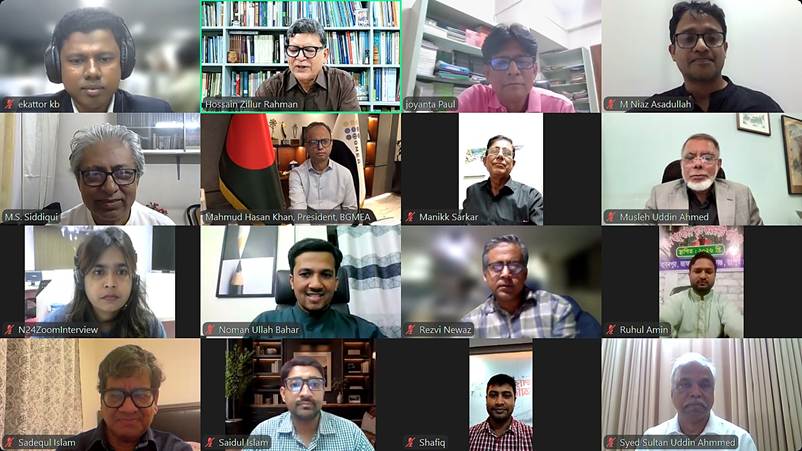
Speakers and participants at the PPRC Ajker Agenda virtual dialogue on “Garment Workers’ Wages: Fairness and Industry Development”, 22 November 2026.
Syed Sultan Uddin Ahmed, Executive Director of BILS, identified the absence of a national minimum wage and clearly defined criteria for wage determination as major institutional weaknesses. Although existing legislation provides for consideration of living costs, commodity prices, productivity and industrial capacity, these criteria have not been adequately operationalised. He argued that workers’ actual living costs, informed by credible evidence including PPRC’s State of the Real Economy survey and BBS data, should provide the primary basis for determining wages.
He recommended that the Minimum Wage Board develop its own research-based proposal rather than beginning negotiations solely with competing submissions from workers and employers. Such an approach could reduce the mistrust that arises when divergent wage demands become the starting point for negotiations. He also emphasised that industrial capacity must be considered without losing sight of workers’ basic needs, and that government support through housing, healthcare, essential commodities and social protection should complement wage policy.
“The Minimum Wage Board should have its own research report. It should examine the available evidence and prepare a proposal, instead of starting with two widely divergent demands.” — Syed Sultan Uddin Ahmed
Mahmud Hasan Khan, President of BGMEA, acknowledged the importance of fair wages while drawing attention to pressures confronting garment manufacturers. He reported that 287 factories had closed over the previous three years and that 669 factories had been affected by recent unrest, with disruptions ranging from one to 21 days. He emphasised the importance of considering inflation, previous wage adjustments, productivity, infrastructure constraints and international competitiveness in determining the new wage structure.
Highlighting the distinction between minimum wages and take-home earnings, he stated that a worker could earn approximately Tk 19,520 per month, including 78 hours of overtime, attendance bonuses and other applicable incentives. He also reported that BGMEA had engaged with 82 registered and unregistered labour federations in an effort to encourage dialogue during the wage revision process. He supported a permanent wage-setting framework, with clear guidelines for future adjustments, to reduce uncertainty and recurring tensions.
“At the end of the day, we need a permanent framework. Once this wage revision is settled, we should agree on guidelines for how wages can be revised each year.” — Mahmud Hasan Khan
Taslima Akhter, President of Bangladesh Garment Sromik Samhati, challenged reliance on overtime earnings as a measure of wage adequacy. She argued that minimum wages should be determined on the basis of normal eight-hour working days, without overtime becoming an economic necessity for meeting basic expenses. She highlighted workers’ proposals of Tk 30,000 for apprentices and Tk 32,000 for Grade 4 workers, alongside adjustments to other grades.
She emphasised that a dignified wage must enable workers to afford nutritious food, suitable housing, education for their children and adequate healthcare. Dignity, she argued, is also inseparable from the right to organise and exercise freedom of association. Welcoming the reduction of the wage revision interval from five years to three years, she called for greater institutional trust and meaningful implementation of workers’ rights.
“Dignity is reflected in what food a worker can eat, the kind of home they can live in, where their children can study, and the healthcare their family can receive.” — Taslima Akhter
Anwarul Alam Parvez, President of BCI, highlighted the broader challenges facing the garment industry, including stagnant export earnings, rising financing costs, inadequate infrastructure and declining competitiveness. He noted that export earnings had remained broadly within the $36–39 billion range over recent financial years. Greater attention to industrial diversification, skills development, technical education and higher-value manufacturing, he argued, would be essential to expanding employment opportunities and strengthening the economy’s capacity to support higher wages.
“If we address these other problems, we can become more competitive. We have very little margin and no cushion; time and the cost of doing business are critical.” — Anwarul Alam Parvez
Dr. Musleh Uddin Ahmed, Independent Member of the Minimum Wage Board, outlined the Board’s efforts to arrive at an acceptable wage settlement. He reported that members had visited factories in Chattogram and Narayanganj, consulting workers and employers across establishments of different sizes. He also referred to government commitments concerning healthcare facilities in six labour-intensive areas, highlighting the importance of complementary welfare measures beyond wages.
The discussion drew attention to the broader responsibilities of government, industry and other stakeholders in ensuring workers’ well-being. Participants pointed to high housing costs, limited affordable healthcare and the absence of adequate public support for essential consumption. Wage increases alone, they noted, cannot fully address these challenges without corresponding improvements in public services and social protection.
In his concluding remarks, Dr. Hossain Zillur Rahman emphasised the distinction between minimum wages, living wages, dignified wages and actual take-home pay. He argued that the policy objective must go beyond a dignified wage to securing a dignified life, encompassing affordable housing, healthcare, education, transportation and other essential services.
“We must focus not only on a dignified wage for workers, but on a dignified life. Housing, healthcare, education and transport are also part of that life.” — Dr. Hossain Zillur Rahman
He identified two areas of convergence. First, despite differences over wage levels and methods of calculation, representatives of workers and industry recognised the need for a more systematic basis for wage determination. Second, there was broad agreement on establishing a permanent institutional framework to make future wage revisions more predictable and credible.
Dr. Rahman highlighted the responsibility of policy researchers and institutions to provide reliable statistics and credible analysis. Trust in wage-setting, he observed, depends not only on negotiation but also on confidence in the evidence informing decisions. He expressed hope that the forthcoming Wage Board meeting would contribute to a fair and acceptable settlement while laying the groundwork for longer-term reform. Workers’ grievances must be understood in context, he stressed, even as industrial disorder cannot offer a sustainable solution.
The dialogue underscored that fair wages and industrial sustainability need not be competing objectives. A durable solution will require transparent criteria for wage determination, credible evidence, greater institutional trust and a broader public policy commitment to a dignified life for Bangladesh’s garment workers.
IN THE NEWS
English Newspapers
- The Daily Star: Fair RMG wages must go beyond inflation
- The Financial Express: Labour, industry leaders call for permanent wage-setting framework for RMG sector
- The Business Standard: ‘Give us Vietnam facilities, we will pay Vietnam wages’: BGMEA president
- The Business Standard: Owners may table wage proposal at Monday’s meeting as RMG unrest nears 3 weeks
- New Age: Stakeholders for clear basis, permanent framework for setting RMG workers’ wage
- Daily Sun: Analysts, BGMEA chief call for research-based permanent wage policy for RMG sector
- Daily Sun (print edition): Read the article
- Dhaka Tribune: RMG stakeholders call for permanent wage-setting framework
Bangla Newspapers
- Prothom Alo: জাতীয় ন্যূনতম মজুরি নির্ধারণের প্রস্তাব
- Samakal: সব পক্ষের কাছে গ্রহণযোগ্য মজুরি কাঠামো দরকার
- Bonik Barta: Read the article
- Jugantor: Read the article
- Dainik Amader Shomoy: Read the article
- Shampratik Deshkal: Business | National | Report
- Dainik Amader Desh: Read the article
- Agamir Somoy: Read the article
Online Portals and TV
- Deshkal News: Read the article
- Muktokontho: Read the article
- Dainik Odhikar: Read the article
- The Daily Campus: Read the article
- Newsdesk BD: Permanent wage framework called for by RMG stakeholders
- Bangla Stream: Read the article
- Gono TV: Read the report
- News24: Read the report