
Bangladesh’s youth challenge is not simply a shortage of skills or even a shortage of economic opportunities. The more fundamental problem is that opportunities are failing to translate into jobs, viable enterprises and dignified livelihoods because the institutions that connect policy with people are not working effectively enough, according to a new study by the Power and Participation Research Centre (PPRC).
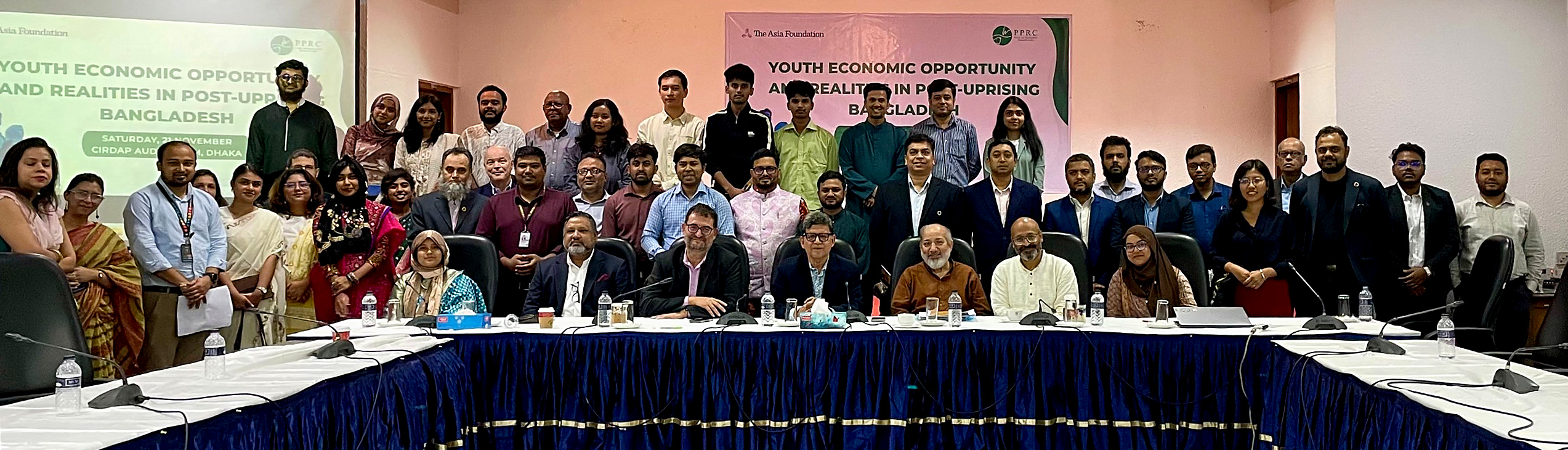
PPRC Executive Chairman Dr Hossain Zillur Rahman and Senior Research Associate Namira Shameem co-presented the findings at a national dissemination event titled “Youth Economic Opportunity and Realities in Post-Uprising Bangladesh,” organised by PPRC with support from The Asia Foundation.
Dr Rahman described this institutional gap as Bangladesh’s “missing middle”—the space between macro-level policies and the efforts of households, young people and entrepreneurs.
“Opportunities may be created, but they are not always being turned into outcomes,” Rahman said in his closing assessment of the discussion.
The rapid regional diagnostic was carried out between August and September 2026. It brought together separate consultations with young people and employers in Rajshahi, Jashore and Chattogram; a brief questionnaire completed by 100 young people and 59 employers and entrepreneurs; and additional field engagements in Naogaon, Pirganj, Jashore High-Tech Park, coastal Noakhali and indigenous communities in Bandarban.
The study is not a nationally representative survey. Instead, it examines how economic barriers operate in practice and why apparently available opportunities become difficult or impossible for young people to use.
Situating the regional findings within a wider labour-market crisis, the study finds substantial economic potential across the regions, but different institutional bottlenecks prevent it from translating into jobs and livelihoods.
In Rajshahi, horticulture and mango production offer opportunities in processing, logistics and marketing, but storage, testing, finance and other support remain weak. In Jashore, digital, light-engineering, flower and women-led enterprises, including businesses built around local food and culture such as pithas, have outpaced the institutions serving them, while the underused High-Tech Park highlights the gap between public investment and productive use. In Noakhali, value is lost because products such as soybean are processed elsewhere, while seasonal businesses face poorly designed finance and women encounter barriers to credit. In Chattogram, employers report skills shortages while young people struggle to gain the experience required for entry-level work, revealing a broken education-to-employment transition. In Bandarban, opportunity is constrained by weak access to markets, infrastructure and services, even as local youth and communities innovate through residential schooling, practical trades and youth-led STEM learning for indigenous children.
A central finding of the study is that young people and employers are not describing two separate problems. Both recognise economic opportunity. Both identify shortages of practical capability. Both see finance as poorly suited to small and youth-led enterprises. But they differ over responsibility. Employers ask why graduates are not work-ready. Young people ask how they are expected to acquire experience when few employers provide the first opportunity to obtain it.
PPRC argues that the transition into productive employment therefore cannot be left to young people alone. Training institutions, employers, financial institutions and government agencies all have a role in making the transition work.
Drawing on the study and the discussion, Dr Rahman’s closing synthesis highlighted seven broad priorities: putting the meso-economy—the institutions where opportunities are converted into outcomes—at the centre of reform; reimagining local governments and educational institutions as catalysts for regional transformation; shifting from training and certificates towards practical capability, mentoring, self-learning and resilience; examining and reducing the high rate of entrepreneurial dropout; holding public assets accountable for productive use and results; broadening economic diversification to include regional products and the creative economy; and embedding inclusion, dignity and voice in economic policy so that women, indigenous communities and other marginalised groups can access meaningful opportunities and participate in decisions that affect them.
Rahman argued that the economic aspirations associated with the July uprising were ultimately about more than employment numbers. They were also about fairness, dignity, access and economic justice. The challenge now, he said, is to move from opportunity to outcome.
Opening the event, The Asia Foundation’s Bangladesh Country Representative Kazi Faisal Bin Seraj welcomed the diversity of participants and underscored the importance of productive and meaningful employment not only for economic prosperity, but also for young people’s sense of participation, ownership and stability.
A written message from the Finance Minister, Amir Khasru Mahmud Chowdhury, who was unable to attend because of state duties, also stressed that expanding productive employment for young people must remain central to Bangladesh’s economic agenda and called for practical measures to remove the barriers facing youth.
Dr Imran Matin, Executive Director of the BRAC Institute of Governance and Development (BIGD), stressed the need to address frontline institutional bottlenecks and strengthen local government, rethink training around competence rather than certification, develop better risk-management mechanisms for youth entrepreneurship, draw lessons from microfinance, and strengthen mentorship and apprenticeship-based learning.
“The growth model is no longer sufficiently inclusive. There are clear ruptures in the mechanisms that translate growth into jobs, and addressing them will require renewed attention to skills, firms, finance and private investment,” said Jean Pesme, World Bank Division Director for Bangladesh and Bhutan.
Speakers identified gaps between education, skills and jobs, stressing that training alone cannot ensure employment. To address these gaps, they proposed industry-led learning, apprenticeships, job tracking, market-based curricula, youth databases, employment centres, internship platforms, accessible finance, regional processing and enterprise support. They also urged AI-readiness, youth policy participation, mental-health support, and stronger links between budgets, policies and measurable outcomes.
The event brought together young people and entrepreneurs from the study regions, alongside researchers, development practitioners, representatives of development partners, civil society, academia, business, local government and the media, to discuss the economic aspirations, opportunities and challenges facing Bangladesh’s youth in the aftermath of the July–August 2024 uprising.
In the news: PPRC study on Youth Economic Opportunity and Realities in Post-Uprising Bangladesh
We are grateful to the print, online and broadcast media for their wide coverage of PPRC’s study, presented on 21 November 2026 at the CIRDAP Auditorium, Dhaka, with support from The Asia Foundation.
Read and watch the coverage:
English newspapers
The Daily Star: https://www.thedailystar.net/business/economy/news/finance-gaps-hinder-youth-jobs-pprc-study-4329786
The Financial Express: https://today.thefinancialexpress.com.bd/trade-market/bds-missing-middle-holding-back-youth-employment-pprc-1795278479
The Business Standard: https://www.tbsnews.net/bangladesh/young-people-struggle-find-jobs-despite-available-opportunities-1609501
Dhaka Tribune: https://www.dhakatribune.com/bangladesh/425350/pprc-study-weak-institutions-prevent-youth
Daily Sun: https://www.daily-sun.com/bangladesh/910476/youth-opportunities-fail-to-create-jobs-pprc
New Age: https://www.newagebd.net/post/country/323560/economic-opportunities-fail-to-translate-into-jobs-study
TOB News: https://tob.news/pprc-study-flags-institutional-youth-bottlenecks/
Bangla newspapers and online portals
প্রথম আলো: https://www.prothomalo.com/amp/story/business/economics/1jgau5vy1n
যুগান্তর: https://www.jugantor.com/tp-firstpage/1187827
বণিক বার্তা: https://bonikbarta.com/economy/zwYnjcZV6prOktKX
বাংলাদেশ প্রতিদিন: https://www.bd-pratidin.com/city/2026/11/22/1329262
নয়া দিগন্ত: https://dailynayadiganta.com/post/other/1071518
সমকাল: https://samakal.com/bangladesh/article/384403/
আজকের পত্রিকা: https://www.ajkerpatrika.com/business/ajpy9qooadl6j
আমাদের সময়: https://www.dainikamadershomoy.com/details/01a1ff69d5de7
সম্প্রতিক দেশকাল: https://www.shampratikdeshkal.com/national/172782 | https://www.shampratikdeshkal.com/report/172786
সময়ের আলো: https://www.shomoyeralo.com/news/397043
জাগো নিউজ: https://www.jagonews24.com/economy/news/1182239
টিবিএস বাংলা: https://www.tbsnews.net/bangla/bangladesh/news-details-568936
Entrepreneur BD: https://www.entrepreneurbd.com/23452
চ্যানেল আই অনলাইন: https://www.channelionline.com/youth-not-getting-jobs-despite-possibility-pprc/
ইনডিপেনডেন্ট টিভি অনলাইন: https://www.itvbd.com/amp/economy/278410/
NPB News: https://npbnews.com/business-news/61653
ঢাকা মেইল: https://dhakamail.com/national/344577
প্রিয় বাংলাদেশ: https://dailypriyobangladesh.com/economy/1ee71d00
বরেন্দ্র পোস্ট: https://www.barindpost.com/news/XEZ4KY5mA0
সময় নিউজ: https://somoynews.com.bd/news/bangladesh/b04ca3b24208
তালাশ: https://talashbd.com/news/1600063352315001
Television
Desh TV: https://youtu.be/q9S7zu5upBc
Jamuna TV: https://www.facebook.com/share/v/1GUAPTVhTf/
Star News: https://www.facebook.com/share/v/19VcF6MtKb/
71 TV: https://www.facebook.com/share/v/1F5as7y42H/
Channel 24: https://www.facebook.com/share/v/18rhRTkU2P/
#PPRC #YouthEmployment #MissingMiddle #Bangladesh #TheAsiaFoundation #InTheNews


