
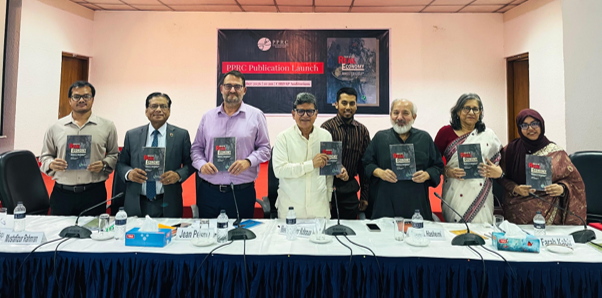
Poverty in Bangladesh is rising rather than declining, the middle class has become more vulnerable, and household coping mechanisms have reached their structural limits. These and other findings were revealed at the launch of the flagship PPRC publication State of the Real Economy: Dynamics of Reversals and Resilience in Bangladesh, co-edited by Hossain Zillur Rahman and Namira Shameem on Saturday, 17 October 2026, at the CIRDAP Auditorium in Dhaka.
The event brought together researchers, business leaders, development practitioners, agricultural specialists, and media representatives to examine the economy through household experiences and discuss the challenges of transition. In his welcome remarks, Dr. Syed M. Hashemi, PPRC Trustee Board Member, highlighted the publication’s contribution in connecting household realities with sectoral developments and the wider economy. Following the formal unveiling, Dr. Hossain Zillur Rahman, Executive Chairman of PPRC, and Namira Shameem, Senior Research Associate, jointly presented the findings and policy priorities.
Building on PPRC’s nationally representative survey of 8,067 households conducted in 2025, the presentation advanced a new poverty narrative with three connected elements: poverty reversal, the emergence of a fragile middle, and deepening vulnerability across everyday life.
Hossain Zillur Rahman noted the convergence between PPRC and World Bank findings on poverty reversal and the growing vulnerability of the middle class. PPRC estimated overall poverty at 27.93% in 2025, compared with the BBS Household Income and Expenditure Survey estimate of 18.7% in 2022. Extreme poverty stood at 9.35%, against 5.6% in 2022. The presentation also highlighted worsening inequality, with the expenditure Gini coefficient reaching 0.436.
Nearly 18% of households were identified as belonging to the fragile middle, representing an estimated 31 million people. Positioned between the poverty line and the median income level, these households remained susceptible to falling into poverty because of stagnant incomes, rising expenditure burdens, and economic shocks.
The findings illustrated how limited households’ financial room had become. Average monthly household income of BDT 32,685 was almost matched by expenditure of BDT 32,615, leaving an average difference of only BDT 70. Households in the bottom 40% spent more than they earned, while food accounted for approximately 55% of household expenditure.
Health costs added a persistent burden. More than half of households had at least one chronically ill member requiring recurring expenditure on medicines and healthcare. Medical expenses triggered approximately two-thirds of reported household financial crises. Inadequate and insecure work, indebtedness, and limited social protection further weakened families’ capacity to withstand shocks.
PPRC combined household-level data and meso and macro trends to underscore that the Bangladesh economy Combining household-level evidence with meso and macroeconomic trends, PPRC argued that Bangladesh’s economy is not merely hostage to geopolitical economic shocks but caught in a rising-poverty-low investment-low growth structural trap.
Jean Pesme, Country Director of the World Bank, welcomed the household-level evidence as an important complement to macroeconomic analysis. He stressed the urgency of structural transformation across trade, public finance, and energy efficiency, alongside stronger alignment between education, labour-market capabilities, and private-sector needs. Productive employment, stronger enterprise capabilities, and more effective social protection were essential to restoring confidence and reducing dependence on private coping mechanisms.
CPD’s Professor Mustafizur Rahman highlighted sharply widening income disparities and Bangladesh’s weaker performance in translating growth into poverty reduction compared with the wider South Asian region. He called for agricultural productivity gains, economic diversification, and stronger technical and vocational education. He also recommended repeated survey rounds to track household transitions over time.
Md. Fazlul Hoque, Administrator of the Federation of Bangladesh Chambers of Commerce and Industry, questioned why sectors long identified as potential growth drivers had failed to scale. He noted that dependence on ready-made garment exports had increased from approximately 73–75% to 84–85% over the period he discussed. He also stressed that degrees no longer guaranteed employment and warned that younger entrepreneurs would be unwilling to visit government offices 30–40 times for routine approvals. Training and education, he argued, needed to be assessed through capabilities and employment outcomes.
Farah Kabir, Country Director of ActionAid Bangladesh, highlighted the pressures facing informal workers amid rising food prices and inadequate wage protection. She drew attention to the unequal burden of unpaid care and the sacrifices through which women absorb economic shocks. As women’s employment in the garment sector declined, she called for alternative livelihood opportunities, including agro-ecology, alongside accessible childcare and gender-sensitive investment. Institutional reform, she emphasised, needed to address unequal power and accountability.
The open discussion gave particular attention to hoirani: the harassment, repeated visits, delays, informal payments, and unequal treatment encountered in everyday transactions. Participants called for systematic measurement of its financial and opportunity costs. Other interventions highlighted chronic disease financing, employment security, regional and climate vulnerabilities, agricultural processing, industry-academia collaboration, and the loss of specialised talent.
In his closing remarks, Hossain Zillur Rahman stressed the urgency of acknowledging the structural trap of household distress, investment stagnation, and unreformed institutions. He called for a comprehensive transition compact built around five pillars: economic democracy, new growth drivers, quality education, productive transformation, and governance reforms for speed and results.
Underscoring the importance of assessing the state’s shortcomings through people’s lived experiences, he described hoirani as an all-pervasive phenomenon across institutions and governance that drains people’s energy, initiatives, and dreams. Creating an economic and political governance system free from hoirani, he argued, must become a core focus of structural reform.
He also outlined PPRC’s intention to repeat the real economy study and develop a household panel, subject to resources, alongside further research on rural transformation and hoirani. People’s determination to persevere, he emphasised, must be met by institutions that make life easier, support productive initiative, and enable a more secure economic future.


